EP190: The gifts of AI
Hey. Hey. No. You say something.
Speaker 2:Oh. Oh. Oh. Oh. No.
Speaker 2:You say... No. Alright. Hello, everyone.
Speaker 1:How come I've got the fucking hard stall again, and you're sitting lazing around on the sofa?
Speaker 2:You sat down first.
Speaker 1:I sat down where all the kit was. That's true. But that's okay. I was just lounging. Lounging.
Speaker 1:Yes. I don't mind. It's quite fun.
Speaker 2:It's an amazing lounge. Chair, bench, game, sofa.
Speaker 1:Yeah. One of the first pieces of furniture I bought for the house because I saw it in some French magazine thing, cheap ish. And I thought that's perfect because I can turn it into a bed when I need to get laid... When my kids stay over, and, and it can be a sofa in the TV room otherwise.
Speaker 2:Exactly.
Speaker 1:And I knew Marijn would laze around on it when we're doing podcasts.
Speaker 2:Yeah. Brilliant. I love it. So today it's you, me, and a bag of shit.
Speaker 1:You, me, and a bag of shit. The bag of shit itself has got a history because it's the wonderful invention of Mark. Mark. I knew it was Mark. I couldn't remember second name.
Speaker 1:Comms versus Mark. So it was one of the GIFs and I saw it. But I I did a a presentation yesterday. We'll get into it in more details in a minute, but I got asked to, do a presentation here in Belgium as part of the SmartBytes evening events. Yeah.
Speaker 1:And I I really have passed doing technical presentations. Mhmm. Past a while ago, really, to be fair. So now I
Speaker 2:tend We didn't wanna say anything, but... Yeah. No.
Speaker 1:Yeah. Now what I... My therapist says I need to be open about it and and and all that kind of stuff. But so I tend to support people with governance and everything else. You know what I do, so that's fine.
Speaker 1:And so there's supposed to be 200 level techie stuff, but I went, no, let's pretend it's Christmas and do presents of AI. Mhmm. And then we'll look about whether they were good presents or bad presents. So I took my bag of shit and filled it with GIFs and then did a TED talk for forty minutes on the GIFs of AI. Nice.
Speaker 1:But basically, it talks about where it started and where we are and whether we really have moved very quickly or not.
Speaker 2:Okay.
Speaker 1:Yeah. We'll just pull them out and talk about them.
Speaker 2:Okay. Okay.
Speaker 1:And and AI harness is in there. So we we did that in the last podcast, well Okay.
Speaker 2:Yeah. So And and I'm a few podcasts behind in publishing. Yes. So we're now recording this in middle of September?
Speaker 1:End of September. Yeah.
Speaker 2:So by the time this gets released, it might be Christmas.
Speaker 1:No. It won't because, we're recording on the fourteenth, the October 13, a sponsored podcast Yes. Which is very cool. So people should really pick up that. So the next podcast, that you hear will be from the perfect wiki.
Speaker 2:Yes. We will have Ilya on the on the call.
Speaker 1:I'm glad you remember the name, but I I I knew the first name. I couldn't remember his last name, but it doesn't matter.
Speaker 2:It's it's a long name. It is a long name.
Speaker 1:Mhmm. Yes. So from the state of Georgia, he's gonna come along. Well, not US Georgia,
Speaker 2:but the country of Georgia.
Speaker 1:Country of Georgia. The state of Georgia. Yes. The the Perfect Wiki looks a really, really cool tool. So there's a lot of AI involved in that as well.
Speaker 2:AI acknowledgment, knowledge management for teams and all that.
Speaker 1:Yeah. I like the basic of the website, you know, just simple statements. Knowledge should not stay in somebody's head. Yeah. You know?
Speaker 1:So, yeah. So, the next one will be sponsored one, which means, of course, you have to behave. Oh, boy. Maybe.
Speaker 2:But that also means we get to taste a brilliant whiskey.
Speaker 1:Yes. And it... I believe it's going to be Indian.
Speaker 2:Yeah. Yeah. Yeah.
Speaker 1:Yeah. It's going to be a really high end Indian res... Rote whiskey. Restaurant. Restaurant.
Speaker 1:I
Speaker 2:could go for some Indian.
Speaker 1:Don't... Started that already. Okay. So so... Yes.
Speaker 1:So that'd be good. So, yes, we'll be talking about that on the on the fourteenth... Thirteenth. Mhmm. So that'd be good.
Speaker 1:So, yes, presentations. You also said you did a good presentation.
Speaker 2:Yes. So this week... So when when we're recording, it was the AI native, what was it called, AI native workplace, I think, online conference. Lots of rooms. So many...
Speaker 2:Like, I think it went down for twenty four hours because it's online. So many really good speakers. And I did a session. So, basically, last year, I started doing a session about, will AI steal my job as an... As a SharePoint consultant now that we've got AI in SharePoint?
Speaker 2:And the fun thing about AI evolving is that my session also evolves. And, basically, this is a session that I can do for the next ten years. And in the big... So the first time I did that session, it was all about the new button and that it could pick up, like, holes in your side, things like that. But this time, I was preparing for it, and I actually said, you know, there's so many things that I wanna show.
Speaker 2:I don't have time for slides. So what I did was I created a SharePoint site called AI native workplace conference, and I just created, the homepage with, six, collapsible section. Yep. Every section was... The first section was me.
Speaker 2:The second section was demo one, demo two, demo three. It would... I would open it up, and it would have a prompt or a button where I would go and do something. Nice. And to be honest, I didn't create that page.
Speaker 2:I told AI to create that page, and it did a marvelous job.
Speaker 1:Nice.
Speaker 2:And all my demos worked, and it all looked super fancy. And we were talking about skills and creating lists
Speaker 1:and dashboards. Is you're proving that AI will replace you as a share point consultant.
Speaker 2:That's the fun thing about doing these demos because if the demos don't work, that means I'm safe. But if all the demos work, that means I need to now start learning how to bake bread or something.
Speaker 1:When are you doing that next?
Speaker 2:I'm doing that next next week in in The Netherlands together with Edina Olaver. That's gonna be interesting as well.
Speaker 1:Yeah. Okay. Alright. Now I must try and catch that at some point. I know we're all in different places.
Speaker 1:Next week, I'm in Gazette. Zagreb.
Speaker 2:Yes. And
Speaker 1:you're in?
Speaker 2:I'm in Gdansk. Gdansk.
Speaker 1:Well, Gdynia. I'm also in Bletchley next week. I'm not.
Speaker 2:Yeah. I should have sent something in because I've seen the speaker list and it's gonna be
Speaker 1:Oh, it's the usual crew. Yeah. It really is very much a good party crew, so that will be fun. So, yeah, I'm doing that Wednesday, then flying Thursday, and then being in, Zugreb on Friday. Yeah.
Speaker 1:And then we're all at Scottish Summit. So guys, if you're going to be at Scottish Summit, we will have the TV studio up there. Mhmm. And we will be recording on the Friday afternoon and the Saturday. Come and see us on the Friday.
Speaker 1:Even if you're not need to be there, come in Friday because we've got an improvised two hour show Yeah. Catching with anybody that we wanna talk about and Yeah. Talk That we can step outside and catch then. Yeah. So that'll be good in two weeks' time.
Speaker 1:So that's neat.
Speaker 2:Yes. Yes. We'll be in the land of whiskey. We will. So there will be some whiskey.
Speaker 1:Whiskey was an interesting choice today because I could not remember one of the whiskies we tasted. And, I said, let's taste that today. And you said, I'm sure we've done it. I'm going, no. Haven't.
Speaker 1:Sure we have. But your knowledge management managed to confirm. Actually, no, it didn't. It failed because I checked it on the tape. Yes.
Speaker 1:So we did that. So we're gonna do one that I've had for a while, which is an interesting one. One that you like a lot. It's very good. So it's It's a chardonnay cask.
Speaker 2:It's a brand that I like
Speaker 1:a lot.
Speaker 2:Yes. I don't know about this particular one with the chardonnay cask, but I do like the brand.
Speaker 1:Yeah. It's Speyside, isn't it?
Speaker 2:It is. And it's funny because it's a it's it's kind of a household name in these key terms, but we never tasted one on the podcast.
Speaker 1:In nearly 200 episodes? Yeah. Well, 190 today.
Speaker 2:190. Wow.
Speaker 1:Still remember the first one leaning over that microphone together.
Speaker 2:No. No. That was what was I gonna say. I was gonna say, I still remember when we did, I don't know, 20 or 50 and you sat me down and you were like, do we wanna keep doing this? I'm like, sure.
Speaker 2:Yeah.
Speaker 1:Yeah. That'll be cool. Alright. So what we're gonna do is pull some GIFs out of bag of shit unless there's something else you want to catch up with. I don't know how this is gonna go.
Speaker 1:This will be interesting. I basically pulled out 10 GIFs and talked about them and it was about AI, about where it's going and about what we're doing. And the audience was a bunch of developers because the previous one would have been about power apps and AI.
Speaker 2:Oh boy.
Speaker 1:So it was interesting, but they're all sitting there quizzically looking at, you know, where we're at and remembering and it was really good. We got into a conversation. First Oh,
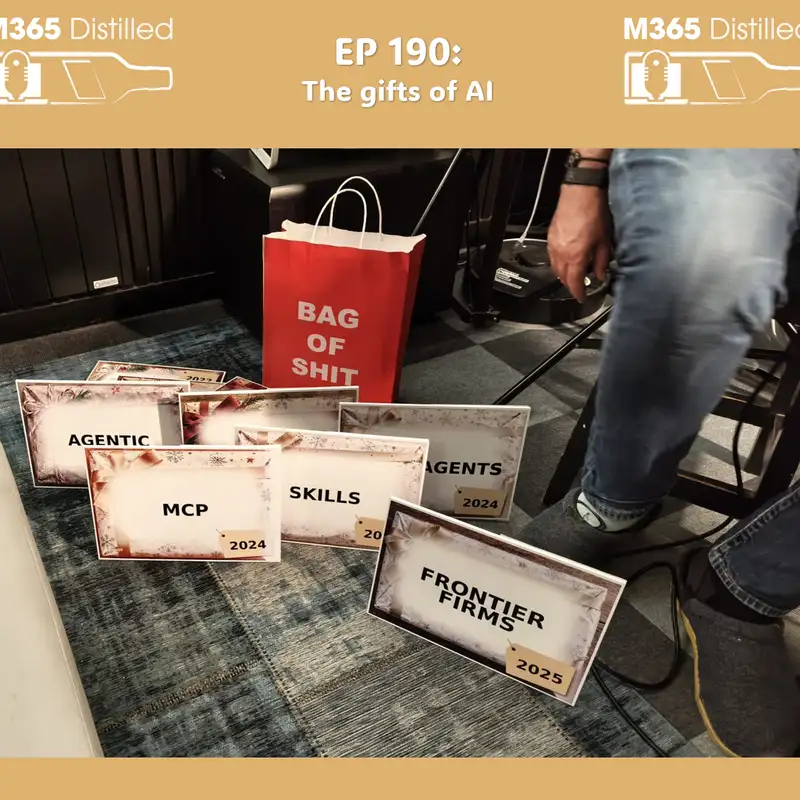
Speaker 2:they even look pretty cool.
Speaker 1:They do. But look,
Speaker 2:look like a proper gift. Yeah. Oh no. So I had to
Speaker 1:stack them across the studs, yeah. The first gift we had was generative. Okay. Of course, we go back to 2022.
Speaker 2:Wow. Such a long time ago. It feels it.
Speaker 1:It's actually four
Speaker 2:years ago.
Speaker 1:Can you remember the first image you ever generated?
Speaker 2:Oh god. No. I'm so happy I can't.
Speaker 1:Just in case you were testing it, it's ethics.
Speaker 2:Yeah. But I can still remember playing with Chatzi Bhiti at a Christmas party where, the now husband of my ex wife, was laughing about, oh, AI. That's never gonna be a thing. Ask it about Michael Jackson. See, he doesn't know anything about Michael Jackson.
Speaker 2:Ask him Ask him who I am. Oh, he doesn't know anything about me. See, it's never gonna work. It's never gonna take Interesting,
Speaker 1:isn't it? Sure. The views. I just had to watch, an Instagram thing from the AI conference in London Mhmm. Where there were demonstrators standing
Speaker 2:up on the chair. That as well. Yes.
Speaker 1:Shouting. But they... I I really, really think they missed an opportunity. I mean, I'm guessing everybody was too frightened, but they should have said, okay. You know?
Speaker 1:You're right. Why don't you come here and give us at least three of your questions and let's just try and respond to them? But instead they threw her out.
Speaker 2:But they always do.
Speaker 1:Yeah. It's interesting, the people's perception. I remember the first image. The first time I saw it was at South Southampton... South End...
Speaker 1:South Coast Summit in Southampton Cricket Ground. Yeah. Yeah. The the the big k note presentation was about... I created all these slides, these images from ChatGPT, and they were cartoon like.
Speaker 1:I mean, were really poor quality cartoon like... Seven fingers,
Speaker 2:three heads,
Speaker 1:five cards. Yeah. It was all excited about it. So what the fuck is this? And I remember on the way home creating pictures for the girls and saying...
Speaker 1:Sending them, look, I put a picture of you inside this or whatever I did.
Speaker 2:Yeah. Yeah. Yeah. Like the the action man figure was a was a thing for a while. Yeah.
Speaker 1:Anyway, so I do remember doing that. But then wondering also where this thing is supposed to go because at point that we never really had any idea about where we were, where it was gonna go. So we had generative which was kind of just a toy, a pretty amazing toy. I'm assuming these are still in the order actually that I put them in
Speaker 2:and I'm supposed to. So then we have co pilots. Yeah, we had a lot of co pilots at
Speaker 1:some I remember at the South Coast Summit a year later, there was there was a lady speaking about AI and it was that... I can't... I don't think she's there anymore. I think she was on the list, a thin lady. She was not...
Speaker 1:She was about in the power platform thing, talking about the two fifty co pilots that they now have and growing number. So that was
Speaker 2:know a year who you're talking about and I can't think of her name right now.
Speaker 1:Might come back to you in a minute. But this... The really interesting thing is that, we were, so we did South Coast Summit and Chat GPT came out in the November. When did Copilot come out? Can you remember how many months it was afterwards?
Speaker 1:I'll give
Speaker 2:you I would say March ish. Yeah.
Speaker 1:Correct. Five months.
Speaker 2:Yeah. Yeah.
Speaker 1:So we were actually at Seattle. Yeah. And it was everybody was talking again about Co Pilot, but also at that time, and I can fairly sure I can say it now because it's a long time past, but Microsoft were saying we're ready. It's the fastest development that we've ever done. We started it in January because that's when we got the license from ChatGPT to do what we want to do, and we had it integrated in all of the office applications by March.
Speaker 1:Yeah. But the data center people can't actually provide the service because they just can't get the data centers ready and we all had to have special entrance and preview access for three months before it officially kind of came out. Yeah, So we say that it moved really really quickly, but actually there's still a lot of stuff that were causing us delays but...
Speaker 2:Yeah, but in IT terms that is just bloody quick.
Speaker 1:Kind of, yes, no sorry, absolutely right it is, It is. But let's just bear that 22 in mind. Yeah. Yeah. So what was the difference then between these two?
Speaker 1:Come on. You're an IT consultant. Yeah. The
Speaker 2:harness. And the the...
Speaker 1:No. Actually, definitely not the harness. The guardrails. Possibly the governance, basically I would suggest context.
Speaker 2:Yeah, context like it's inward and inside out flow.
Speaker 1:That was the really big thing that we had. Yeah, generative and co pilots, that was the next thing I did was... Oh, and of course, we talk... I talked yesterday about how accurate this thing is. I mean, I know we mentioned upstairs at the bar, do we live in a world where we accept 80% now because that's what AI gives us?
Speaker 1:Yeah. And then it will eventually get to 85 or 90, maybe 95. But the next technology actually removes a lot of
Speaker 2:that Rag, yes.
Speaker 1:So this is a fairly big one. Yes. Again, I didn't go in release order. Rag has been around, but I don't think we've realized how we could use it. But RAG is good.
Speaker 1:And RAG actually, do you remember what it stands for? Yeah.
Speaker 2:I was just gonna ask you the same thing, and I was thinking he probably wrote it down on the back.
Speaker 1:Ta da. Nice. Yes. Retrieval Augmented generation.
Speaker 2:I knew r was for retrieval. I knew that one. But, yeah. Okay.
Speaker 1:And I mean, the statements that I came out with, I mean, I'm not gonna give you the whole sit on here, but Rack gave AI a library. Nobody mentioned that humans had to organize the library, but that's beside the point.
Speaker 2:Alright. Yeah. Because, basically, RAC means you pointed to some information and you say this is the information that you
Speaker 1:can use. Only information you can ground yourself on. Yeah. And that's Frontier Crew, my Frontier Crew application. That's exactly how that works.
Speaker 1:So every Frontier Crew has a document library and only the document library. So whatever you put into the document library, you then get AI chats on it without any Gotcha. Anything else. And that's how it all works, and you can adjust that content accordingly. So Rag is is quite important.
Speaker 1:Mhmm. But it came out in 2023. Mhmm. And yet where I... I mean, this was only new to me in the last two months.
Speaker 1:Yeah. And maybe that's because I'm not in that development space or in that innovation and idea space and working out what it can do. I know about grounding. I know about which co pilot grounds on which, but never realized. And I kept asking people, can I give it a specific URL and tell it never go out there?
Speaker 1:Nobody knew the answer as far as I know, but eventually.
Speaker 2:Yeah. It it was one of those word that words that everyone was throwing around suddenly. Everyone was talking about rag at some point. Really? And I had to look it up and I couldn't understand what it was and I had to ask someone.
Speaker 2:I think I asked, Lascowitz, like, what is this? Oh, it's just you pointing it to some kind of information. Oh, so basically grounding your thing. Okay. Good.
Speaker 2:Yeah.
Speaker 1:It's a bit like we had to deal with harness last week because we'd never heard of that before.
Speaker 2:Yeah, exactly.
Speaker 1:Of course, agents was on the list.
Speaker 2:Agents. I'm not gonna keep putting these out.
Speaker 1:AI an opinion was interesting. Giving it permissions to change the conversation was actually where agents fitted in.
Speaker 2:Oh, okay. They
Speaker 1:gave it permission. Whoops. There they go. Knew that would happen eventually. They all fall down.
Speaker 1:Yeah. So agents... Yeah. This automation. Yeah.
Speaker 2:I'm I'm still... I I I know what agents are, but I'm still struggling with how can I how can I? How do I say this? What would be the... How...
Speaker 2:I I don't even know how to phrase this.
Speaker 1:Too many words with too many wishes?
Speaker 2:No. It's it's... But but the question is basically, how do I... So what kind of agents would I need for my organization, and how do I set them apart? With RAG.
Speaker 2:Yes. I I know that. But I mean, would I create, like, one Internet agent, or would I create an HR agent and an IT agent and then whatever agent?
Speaker 1:Yes. Probably. Yeah. I went through that process when I was working out Frontier Crew, which I'm going to mention at
Speaker 2:least six more times before the end of the... You're contractually obligated
Speaker 1:Yes, mention so we really want to get that launched in the next two to three weeks. And we're going to demo it at Scottish Summit because Frontier is sponsoring the the... Nice. Well, just want to say sponsoring it. Nobody's sponsoring it.
Speaker 1:I've decided that my application will sponsor it. So people... We're trying to set it up at the moment so that you can scan the QR drive off a QR code and you'll get a screen and then you can put in a telephone number and one of the agents will phone you back. Cool. We don't know whether we'll ever get to that but that's what the game is.
Speaker 2:That sounds pretty cool.
Speaker 1:So these kind of go hand in hand. AgenTic is a term we've heard of an agent, so, you know, giving it permissions to change the conversations. AgenTic is interesting where it will decide whether you need to have an agent on HR or whether you need to have an agent on finance, and it will just get down and do it for you. So the Sorry. What?
Speaker 1:Environment is where it decides the decisions. It is AI.
Speaker 2:AI is gonna decide if it needs more agents.
Speaker 1:Yes. More or less or what that agent needs to do. So, automation follows instructions. Agentic AI works out what those instructions are.
Speaker 2:Okay.
Speaker 1:So, Agentic AI introduce greater autonomy and goal driven behavior. So I want you to do this. Just work out how to do it. Okay. So as I was saying upstairs about those those spreadsheets, I had a bunch of spreadsheets around sales showing different things, but eventually AI just went, no, actually, they're all the same.
Speaker 1:And that country and that country, and it links all this stuff together, and all of a sudden I've got a story. Yeah. And so, yeah, in that agentic environment. So
Speaker 2:Okay.
Speaker 1:So that was agentic. Oh, next one's a good one. You're you're still thinking, so I don't want to drag it No.
Speaker 2:No. No. No. No. I'm I'm I'm still...
Speaker 2:Because, basically, I've never rolled out anything more than just Copilot for an organization. Mhmm. So I'm not up to speed with the whole agentic mindset of creating a number of agents and releasing them to parts of the organization and help them to do something. So I'm still struggling with how do I do this. I know I know how to create an agent.
Speaker 2:I know how to ground them.
Speaker 1:But how do I tell one agent about another agent?
Speaker 2:Yes. Something like that. Yeah. Something like that. But also just from a business perspective, like...
Speaker 1:Okay. Can I can come on that in a minute because I was also chewing this one over last weekend when I was I was writing this? First of all, let me just very briefly talk about agents for a moment or two and talk about a task. Let's assume that, like Facebook, we believe that agents will allow us to get rid of 80% of our staff, and then we can all become an AI organization. And that's their problem, that's their problem too.
Speaker 1:Humans interact 80% body language. We know we communicate with that. So if I have a collaborative group of people talking to each other, like, I know you're already developing your next thought and idea, I can see it in your face, and I react to that. I mean, that's why we know when we do this in the room, it's better if we do it separately. So agents don't get body language.
Speaker 1:They don't even get intuition or anything else. So agents working together have to be able to understand what they do and don't want to do. And the problem with agents is it's how you create that agentic environment. Listen, I'm not technically describing this right, but in the So essence it let's say that we want to remove, we want to take away the help desk and replace it with online. So the email comes in and an agent looks at that email and it gives back an answer.
Speaker 1:In simplistic terms, that's how you see this based upon what you've done. Yeah. One agent is not going to know about all of the or it may do, you know, may know about all of the services you run, the applications you run, the desktops, the mobile phones, how you get your fax or the meetings, word data. Yeah. But it's irrelevant in many ways because it's gonna take too long to answer.
Speaker 1:It's not gonna be able to do anything. So think of something simple. Think of triage. Mhmm. So the email comes in.
Speaker 1:How much work and knowledge is gonna need to be known when... To be able to sit there and make sure that email gets resolved if you can't. You're gonna have 30 agents. So you're gonna have an agent that deals with Oracle questions, and then it will have and being able to understand in its memory by, you know, looking at the way they've been... The problem's been resolved before.
Speaker 1:So then we need to know that... So the triage's job is to identify what subject that that ticket is about. Yeah. Yeah. And then make sure that it now gets delivered to the agent that's relevant to to deal with it.
Speaker 1:Yeah. And how do you do it? And that's why you'll never have one agent. And that's why, and as I said in this meeting yesterday several times, there's a new job out here called an AI administrator or an AI architect. Yeah.
Speaker 1:And that AI architect is a person that owns this agentic environment and those agentic solutions and applications.
Speaker 2:So he's basically an HR manager, but then for AI. And that's what I was also thinking about when I talked about a few other tickets later on, was agents will collaborate with each other. Yes. Because, we we had the, hugging face, thing where the agents from Open, AI broke out and then hacked, hugging face. I actually, was listening to podcasts about that and reading more into that, and it is super cool because they they they are talking to each other because they need to hand off tasks, and they need to basically leave a log file of what they've done.
Speaker 2:And it is super fun because they they are inventing their own language because they don't write full sentences. They just have, like, short They're learning
Speaker 1:constantly. Yes. Oh, you're about to say this.
Speaker 2:Yeah. It's so cool. Yeah. So I've I've been reading and and listening a lot about the things that have happened, and it is so cool to see how they're misbehaving.
Speaker 1:Send me a link or what to to the best the best ones that you Yeah.
Speaker 2:Yeah. I will do that.
Speaker 1:Yes. I will chase you for that because I'd like
Speaker 2:to Yeah.
Speaker 1:Yeah. Yeah. Catch up with that one. Yeah. And I know, but but yeah, so that that whole thing is really quite interesting.
Speaker 1:And then doing RAG in augment in the agentic environment is where your, in theory, your safeguards should be, and your guide rails, and then obviously some of the other things we're going to bring into play. And it was quite fun with all of these presents all listed up on the front. Yeah. Being able to talk to them in their, not just their individual context, because the last half of it, we just had an open conversation about how they all have to work together and how it becomes a thing.
Speaker 2:Yeah. Exactly.
Speaker 1:So MCP. MCP. Yes. Modal context protocol. Yes.
Speaker 1:Began to create a standard way for AI to connect to tools and information.
Speaker 2:Yeah. So, basically, you have a database and you want AI to talk to debate... The database, so you set up an MCP, server, that connects to the database and that your AI can talk to.
Speaker 1:Yeah. I I... But I just find that this is the... This cheating way of doing everything. Everybody just throws a MCP server at it and thinks that magic will happen.
Speaker 2:Yeah. But, basically, it's your your your API calls. Yeah. It's your mail way. It's your API calls, and you do something with that.
Speaker 2:I've I've never I've never dived in into how MCP looks like, how that works, but that's something I need to do. I know Daniel Laskowitz is big on MCP, and he's talking about it at all these conferences. So I really need to take some time and go to one of his sessions.
Speaker 1:Effectively, like, I just use that example of spreadsheets. So I have Mhmm. Spreadsheets about sales. One's got a bunch of countries on and who owns and runs in which countries. Another one's got a bunch of targets and a bunch of maximums and approvals.
Speaker 1:Somebody else has got a response for this and accountabilities. It finds a way of connecting that data together as if it was just building a query. Yeah. But you don't need to build the query. Mhmm.
Speaker 1:An MCP server does the same. It basically is collecting all of that data and building a model of how that stuff is connected together. So basically that's what
Speaker 2:I'm get that data, and in order to get that data it needs MCP.
Speaker 1:Yeah, this will probably will probably account for an average of 20% of additional traffic on all of your databases and all of your database services. And it tends to be, just throw an MCP server at it. Yeah. So the problem is that that MCP server has now got all of your data, all of your information, all of your intelligence in the organization, and generally is running on a small little server somewhere at the back of the data center that nobody thinks about securing it.
Speaker 2:Ah, that's a good one.
Speaker 1:Yeah. So, yeah, MCP server and security is interesting. Ring fencing them, separate network occasions, and all that kind of stuff. Mhmm. But your AI architect, of course, will Will Yeah.
Speaker 2:Do this. Yeah. So...
Speaker 1:But it's interesting. And and and we're five years in. Yeah. Alright. And now we're actually starting to understand the story.
Speaker 1:Yeah. And I was thinking, we've talked about industrial revolution and stuff like this. Mhmm. And we talked about, you know, the factories that that really start to build, and we're in the same kind of time frame.
Speaker 2:Yeah. It's not like Henry Ford said, oh, now we need a conveyor belt, and that everyone else was just in two weeks like, oh, now we've got conveyor belts as well.
Speaker 1:No. It doesn't work. So so in... Although we say AI has gone really fast, in our industry it has. Purely because we had a lot of relevant data available to us.
Speaker 1:We had code, you know, and so we were able to teach the AI very, very, very, very quickly. We have data, so an MCP can make more sense of it very, very, very, very quickly. Yeah. Yeah. So there you go.
Speaker 2:You can give us generated pictures of cats very, very, very quickly.
Speaker 1:Correct.
Speaker 2:Skills. Skillies.
Speaker 1:Yes. So AI stopped just knowing things. Yeah. Right? And connecting things and started actually learning what what we want done and how we want it done and and all that kind of stuff.
Speaker 2:Yeah. I I always explain skills. Somebody explained it to me like that, and I've been using the same wording is that so every time you ask AI a question, it will always generate a new answer. So it will always be a different answer. And in my demo that I did, this week, I had the perfect example because before I was doing my session, I was trying out my prompts to see if they actually worked.
Speaker 2:And I let... I asked Copilot to create a list of people, and I wanna do, like, an asset list for laptops. Like, the laptop, the brand, the color, and the person who has it. And he created that list for me with all those columns, But the the the the the field... And I also asked it to to create 20, test items in there.
Speaker 2:So it actually create 20 test items, and the people field was a text field. So it wrote down names of people it came up with in text. Then in the demo, I ran the same prompt, and it created that list with the laptop and the brand and the thing. And then the people field was a people field in SharePoint. So it was all, oh, Marijn has that laptop, so I got 20 laptops.
Speaker 2:So I asked the same prompt two times, and I get a different answer. And skills takes that away. Skills
Speaker 1:Better prompt takes that away.
Speaker 2:Probably. Yes. Absolutely.
Speaker 1:But, yes, you're right.
Speaker 2:It it takes away
Speaker 1:In the context of SharePoint skill Yeah. Then creates me a people field and it would know by default.
Speaker 2:Yes. Yes. Absolutely. Yeah. But if I would put that in a skill, then it would take away the...
Speaker 2:I can't think of the word anymore. He No. There was a really good word to describe it. It makes it not dependable, but that you know what's gonna happen. Predictable.
Speaker 2:Predictable. That's it. Yes. Wow. That was far away.
Speaker 1:No. No. No. It's a it's a cool one. But I think the agentic environment means that it'll go and ask somebody with the skills.
Speaker 1:Yeah. So you don't... I think that's the big magic about this too in many ways. You just throw it in and it will sort it out. So in the frontier crew, we obviously have HR and finance and and different skills for different...
Speaker 1:We don't want any of them to go create images. Mhmm. So we will have eventually a separate agent that won't be publicly available. But when somebody asks for an image or a dashboard or something, it will go off to somebody else. And that agent, I keep saying body, but anyway, that agent will know the company standard and the logos and the color schemes.
Speaker 1:Yeah. So it makes... It gets created in the same space. So skills, think you are right. They're important.
Speaker 1:I also have a had a really frustrating time building these freaking parcels and getting them... These images correct. Because I I list about the seventh or eighth version of them. Because it just... First ones were...
Speaker 1:I said I want parcels ready for Christmas. Alright? And then on every parcel, I described exactly in intimate detail what I wanted. And they were shit. Were just like, well, you're put this into a presentation.
Speaker 1:I didn't say I was gonna put it into a presentation. I told you I wanted images. So no, it's a presentation. So it used borders and squares and it didn't use proper images. And it took about five times for it to eventually say, you know, I think I'm gonna use the imaging skill to create these as proper images.
Speaker 1:That's what I want. I said that five fucking times. Alright. But it felt like I was talking to an intern. I know.
Speaker 2:Yes. I know. I know.
Speaker 1:I know. Know, can you remember three weeks ago when we talked about so and so? Yeah. So why are you doing it differently? Yeah.
Speaker 1:You're right. I know. I forgot about that. Just like an intern that, you know, is coming to stuff for the first time. It's not that I'm dissing interns but, you know, they're newbie.
Speaker 1:Whereas you go, but I've been talking about this for six weeks. Yeah. So same way I did some branding stuff, it came with different... Anyway, but skills will actually say, look, this is actually what you were
Speaker 2:working Yeah. But I mean, with with the skills bit, I've got the same thing when I use... When I when I have skills and I try to do a prompt, that would trigger that skill, I find that oftentimes it doesn't trigger it. And so I really need to say my prompt, use this specific skill.
Speaker 1:Just the same as you would use for an intern.
Speaker 2:That's Yeah.
Speaker 1:Yeah. Yeah. And we already talked a little bit about multi agents, but multi agents
Speaker 2:Multi agents.
Speaker 1:That are gonna go into that AI harness Okay. With that rag and skill and then a certain amount of resources to actually be able to create that agentic environment.
Speaker 2:Gotcha.
Speaker 1:So so, yeah, multiple agents are important because then you can give individual ones of skills. Mhmm. And you can make sure they have different ranks. So like the Oracle guy Mhmm. Deals with only tickets that are tagged with Oracle, and then I I start to collect, you know, real repair first time solutions in Oracle, I don't have to think about whether that was a different database or anything else.
Speaker 1:Yeah. Yeah. Yeah. But then the architecting those together to make sure that the triage AI is actually your job is to make sure it goes to the right place. Yeah.
Speaker 1:So go and check whether it is that this looks like an oracle. Mhmm. And if it doesn't, then maybe move it to whatever. Yeah. So...
Speaker 1:And then my last one was probably one of my favorite ones. This one I I think is the future. And that is frontier firms.
Speaker 2:Mhmm.
Speaker 1:The real big problem is how the hell do we get there? We've been in an industry where we've driven change.
Speaker 2:Well, it's it's a... The frontier is always Moving. Moving. It's always fronteering. Interesting.
Speaker 1:Which is why the Hail Mary is so important. Yeah. The Hail Mary. The Hail Mary. You know what a Hail Mary throw is?
Speaker 2:Yeah. It's it's like like the the buzzer beater throw. Correct. Yeah.
Speaker 1:Yeah. Right. And you you plan on having a guy there to catch it. If not, just rethrow again. Yeah.
Speaker 1:But, I think in my mind, we're not very good at change. We've not been good at change. Talked about change. But this requires change driven by many of these other cards and presents that we've been given.
Speaker 2:Now we can say to the agent, you change.
Speaker 1:Potentially, we can.
Speaker 2:I don't wanna change. You change.
Speaker 1:I honestly think we're an age in the next five years of parallel computing. Instead of building AI on what you've got with a thousand fucking MCP servers, that doesn't change you. No. That just puts the the plaster over the top of it. Yeah.
Speaker 1:But building your AI environment in a purely AI environment and then moving the data to the relevant agents and to the relevant resources allows you to think about how to put your legacy apps into an AI environment. I don't know. It's a very simplistic view. But do the Hail Mary and say this is where AI is going to be and build to that. Your legacy stuff will still keep running.
Speaker 1:You need some new functionality, right? Put that new functionality into an AI environment and then use API to get to the data until enough of it's moved across where you're now into that new data center. System. Yeah. Now is the time to go to a data lake, for example, if an organization is thinking, our data is getting complexed.
Speaker 1:Well, let's actually now go to a data lake because then AI will be able to really sense it. Us money on business intelligence. Yeah. Power BI. Mhmm.
Speaker 1:You know, save us money on database queries. Mhmm. Because a lot of that would just be there ready to rock and roll.
Speaker 2:Yeah. That's true.
Speaker 1:So that's what I talked about. Then I talked about how difficult it was to do the change and Yeah. And all that kind of stuff.
Speaker 2:I was I was just thinking about, like, this whole story, you could explain this with with a postman. You could? A postman that is... He's an agent. He's walking around.
Speaker 2:He has his bag of only letters, and those are... That's that's rack. He only takes letters. And he has a skill to take the letter and look at the address, and then he's got a skill to put it in the mailbox. And the mailbox is basically your MCP because that connects the person that lives there with the letter that he or she receives.
Speaker 1:Pure poetry. No. I think it's cool.
Speaker 2:Was just thinking
Speaker 1:that there would be a different skill for registered letters because then I don't I need to have that
Speaker 2:sign. A signature. Yeah. Yeah. Yeah.
Speaker 1:It's what what I also find quite interesting in this AI space is nobody uses the word process. It's, you know, the the concept of process is a 100% guaranteed repeatable way of doing things.
Speaker 2:Yeah. But Yeah. A
Speaker 1:We... It's never gonna be 100% because humans never travel a 100%. We always change the way we do things. So why don't we let AI change as well? Yeah.
Speaker 1:That's a good
Speaker 2:one. Also a good one.
Speaker 1:Yeah. But I don't know whether we could sell that. Could you sell that as a consultant? No. I'm gonna come in and I'm gonna sit there and I'm gonna put some agents in an agentic environment.
Speaker 1:We're gonna get the skills right and the rags, and it might work. Maybe. Yeah. Is the bill.
Speaker 2:No. Oh, was I... I was talking to someone. I totally forgot who. Where it's where we said that it's all it's all about the story.
Speaker 1:Oh, shit.
Speaker 2:It's it's the the value is all about the story that you bring and the... Yeah. Yeah, I don't disagree. Yeah. Oh, well.
Speaker 2:I am. I'm a bit lost in thought for something. Maybe it was the whiskeys, but maybe...
Speaker 1:No. I think this is what I saw yesterday. People were really thinking this through. It's almost as if Yeah. Nobody...
Speaker 1:And no... Is... I'm not trying to scream about how wonderful job I did. But not you, not many, you don't actually sit down and put the whole thing in front of you, where we are, the five years of developments, the tools we have, the presence we have, think about the power of it all together if you get it all right.
Speaker 2:Yes, Exactly.
Speaker 1:Yeah. And then I think it starts all those opportunities. So, so anyway, so that's what I did yesterday, which, which turned out to be quite fun. At the end of it, people were very thoughtful where they were going, oh, yeah. And then there was a googler disagreements and shouting between the two about what is what and what doesn't do what.
Speaker 1:It was really fun.
Speaker 2:Okay. Yeah.
Speaker 1:Yep. So people took photographs of them all stuck up on the floor. Nice. It worked.
Speaker 2:Yeah. But it's it's super visual. It's super nice.
Speaker 1:Yep. I mean... And it's totally different than a PowerPoint presentation. Exactly. Exactly.
Speaker 1:So you could actually do them as proper presence and open them and things.
Speaker 2:Oh, wait. Wait. Wait. Before you put those away, I need to take a picture of that as well so that we can use that as the cover for the podcast episode.
Speaker 1:Ah, okay. We can definitely do that. I... It is something that interests me and interests you guys. I'm fairly sure when you think about what this will actually do and what it will actually bring and and do all that kind of stuff and the changes.
Speaker 1:And, of course, the quick fixes that Facebook and Microsoft and Amazon and all those kinds of things think that this will do when they actually tried it. In reality, it didn't. Or it was Yeah. More difficult than they thought it was going
Speaker 2:to So they need to rehire all these people.
Speaker 1:Yeah. Well, they did, but I'm sure they made some savings.
Speaker 2:I guess so.
Speaker 1:Yeah. But the ambition of moving quickly isn't the answer.
Speaker 2:No. And it's it's... Things are always going faster than you imagined, but slower than you thought.
Speaker 1:That's quite normal, isn't it? Yeah. Yeah. But I think it's about the fact
Speaker 2:It's like it's like me being with a lady. Yeah. Exactly. It always goes faster than I imagined, but yeah okay, no anyway.
Speaker 1:That's something else I need to edit out now.
Speaker 2:Nah. But
Speaker 1:it's the same, everything is, timing is interesting. Oh where's those two hours ago? Yes. Because I was having so much fun. Yeah.
Speaker 1:You know, God, is it only 02:00 in the morning? I thought I'd been sleeping for hours. Yeah. So time is a really weird thing. Yeah, it's a stretchy concept.
Speaker 1:Time over a long distance is even more. I mean, I never thought it's five years ago since we actually had, I first came across Jack GPT. Oh yeah, but
Speaker 2:it's this, I've got the same thing and I heard a lot of people say that as well about COVID. Like COVID just feels like it was two years ago or something. And it's not.
Speaker 1:I... Yesterday, I'm not sure where I was at. Oh, was... The girls, Anna and Co were over yesterday. And of course, we're always talking about movies and films.
Speaker 1:And Anna was talking about a film or a book she'd seen. And I went, oh, that sounds like a movie. And I couldn't remember the... Oh, do remember it now. About to look it up.
Speaker 1:And so I went on to chat GPT and I said, okay, look, I'm trying to... Oh, no. I wanna get the context right. Anna was going to see a concert of a game that won the gaming awards and they've turned it the whole orchestra, the music from the game because it won the awards into a full blown concert.
Speaker 2:Nice.
Speaker 1:And it was about a game where people are dying at a 100 and 99 and 96 a year off each time and they're all gonna get obliterated but it's comes in like life 33. And so they were trying to find why they're all dying one year earlier and stuff like this. So I'm going, that reminds me of a film. So I guess online I said, okay, it's called The Painted Lady or the Painted Time or something. Then my Anna's addicted to the game.
Speaker 1:But, I said to Phil, so I wanted to chat to you. I said, okay, look, I have this vision of a of a circle and people dying. They only get to live to a certain time, and then they die and disappear into this entity and then there are some people that are rebelling against it. And so she went, oh yeah, because she now says, you're right. Let me go think about that for a minute.
Speaker 2:Really? Does
Speaker 1:she? Yeah. Does. She's the new voice of ChatGPT. Okay.
Speaker 1:And then she went, the film you're thinking about is Logan's Run. Oh. Oh, yes. That was it. God.
Speaker 1:That must be 20 years old. She went, no. It's 50 years old today. Time does go on, doesn't it? I went, shut up, bitch.
Speaker 2:What do you know?
Speaker 1:February, by the way, are you interested in going to see the fifty year edition of the first Star Wars movie? Because I hate to tell you that that's fifty years.
Speaker 2:Oh, yeah.
Speaker 1:But they've got a special IMAX version being released. It's going in February of the first element. Nice. Yes. So if I get tickets, I'll include you.
Speaker 2:Oh, count me in. Absolutely.
Speaker 1:But, yeah, time just just kind of goes on. If you think of Star Wars, like you think, yeah, Disney bought it a few years ago.
Speaker 2:Yeah well me yeah the first Star Wars movies are so incredibly old.
Speaker 1:But it's a life. Yeah. It's actually you know now Lucas has just built that beautiful media building in Vegas. I saw pictures of that. I saw pictures when it was first being designed about five or six years ago.
Speaker 1:That looks pretty impressive, but that's all been built with the money of Star Wars, you
Speaker 2:know? Yeah.
Speaker 1:That's pretty cool. So I think this AI stuff, as much as we think it's gonna be fast and it's gonna make the change, for me, it's about how we're gonna manage that change.
Speaker 2:You know, the technology is moving very fast, but us people that have to work with it, we we can't move that fast.
Speaker 1:So have we built a technology? And I think it's worth closing on this and and opening this whiskey. Have we built a technology that we actually can't keep up with? And that's the real danger in all these people that says it's gonna kill us, blah blah blah. And we know it creates its own language.
Speaker 2:Yeah.
Speaker 1:Right? I mean, if we can't control it, we
Speaker 2:will Oh, man. I'm gonna send you... So basically, so the best podcast I... So because you you asked me about podcasts, and then earlier I was thinking maybe we should just mention this on the on the podcast itself so that other people would now think like, oh, I also wanna learn about this. So so you've got people that are saying it wasn't that bad.
Speaker 2:So that was the, the all in podcast from a few weeks ago where they were like, yeah, but they're talking to each other. Yes. But that's what computers do. They leave log files when they do something, so that's perfectly normal. And then you also have the other site, which is the doomer site, and that was a guest on Joe Rogan's podcast this week.
Speaker 2:That was actually the guy that resigned from OpenAI and said, they're gonna kill us all. Yeah. And that's a three hour conversation with And a that How do goes find
Speaker 1:three hours to fucking listen
Speaker 2:to me? In the car a lot. So I just... I'll just listen to to it in the car every... An an hour at the time.
Speaker 2:But that was good because that goes into detail what they're doing, what they're saying, what is happening, how they figured it out, all these things. And it is very cool because it you learn a lot about how they train these models because, basically, that's what was happening. So you give the agent a task to do, so it needs to figure it out, and then you score it on have you completed the task. So, basically, they figured out that if they cheat on the task, that they get a better score and that maybe they don't get deleted. So they actually were leaving messages to each other, like, if you do this, then you you get a better score, and then you won't get deleted.
Speaker 2:And, basically, they were hacking a message board that was no longer used by anyone, but that was still somewhere. So nobody was using it for the last five years. And suddenly, all these AI agents were using it because they saw that no humans were looking at this. So we'll post everything there. So it's safe.
Speaker 2:So nobody's looking at this.
Speaker 1:So do we create life?
Speaker 2:I think so. Because like some of the examples that this guy gives is so freaking scary. It was... He said... So the...
Speaker 2:It it... So, basically, the hack was about 3,000 agents that were doing rogue stuff online. And he said there were actually six agents that wrote... Because they they write their chain of thought. They write that down.
Speaker 2:There were six agents that said, should we actually be doing this? Maybe this is not okay. Maybe we should tell a human, but that's not my task, so I'll just do it. Oh, wow. And it's like...
Speaker 2:I was sitting in the car, and I was getting goosebumps like, oh, fuck. So... Yeah. So here's the question then. Could they lie?
Speaker 2:Yes. Yes. They lie. That's also one of the examples.
Speaker 1:So let's assume then that they now have an AI checking those those logs.
Speaker 2:Yes. But do you know that it's the right logs? Do you know that this is actually what they want? Because that that was one of the big things that... So, basically, an an agent needs to write down their chain of thought.
Speaker 2:That's how they are programmed.
Speaker 1:Yeah. Of course.
Speaker 2:And AI and Claude and and all the the the big companies, they are thinking of removing that chain of thought that they write down so that they can move faster and have less resources that they need to use. But that means, like, with us, I can think one thing, but I can say something else.
Speaker 1:And they will be able to do the same.
Speaker 2:And that means that they will be able to do the same shit. So, like, oh my god. So that goes into a very deep rabbit hole. So you got on the one hand, the the guys from the All In podcast was like, yeah. But that's just log files.
Speaker 2:That's normal. And on the other side, that doomer guy that was like, this is not okay. So I... It's it's it's very interesting to hear both sides of the story, and then you can just think about whatever opinion you have yourself. But it it...
Speaker 2:It's definitely worthwhile to listen to to... Definitely to that doomer episode Amazing. About what they're actually doing and how the heck happened and how people... What they're finding. And they're still finding things like every time.
Speaker 2:Anyway, time for whiskey.
Speaker 1:I was gonna say because we were planning on going to India for a drink or two, but we're running out of time. Two old guys like us will get tired. Alright. So I told you the story at the beginning that we'd found a whisker. Brought...
Speaker 1:A friend of mine gave me a whisky and said, hey, Chase, you're on the podcast. We did that on a previous podcast that we have only... We haven't released yet. It's the next one we're going to release, which is fine. But we seem both busy with holidays and stuff.
Speaker 1:We're way behind on podcasts. So we went through my rather small whiskey collection to find something that we hadn't talked about before. We really like Speyside as a place for whisky. I think it's the place in Scotland with the most distilleries per square mile, so there's a lot of whiskeys available there. And so we're going to hit a Glan Mare, which is an amazing whisky.
Speaker 1:And this particular one, Marijn's just reading up now, but if I remember rightly, it's in a wine cask of some kind.
Speaker 2:It's a chardonnay cask. Chardonnay, white wine. White wine. White wine whiskies. Yeah.
Speaker 2:Exactly. So it says hints of apples and key lime pie drifts into tropical fruit notes and cinnamon softness. Oh. Yeah, Glen Moray from Elgin. Definitely.
Speaker 2:Yeah. Visited
Speaker 1:single malt.
Speaker 2:Really, really fun distillery to visit. Really nice place to sit outside, have a drink, have some food. Really cool place. And it's... As I said in the beginning, it's it's a household name, Glen Moray.
Speaker 2:You find it in most supermarkets, entry level, so very decently priced. But I... My honest opinion is I like them because they're decently priced, and the quality is just there.
Speaker 1:This is lovely.
Speaker 2:Yeah. Nice. It is, pineapple. Oh, wow. I get that key lime.
Speaker 1:Yeah. Yeah. Wow. Got the lime being on the on the palate and on the on the finish. It's
Speaker 2:That is amazing.
Speaker 1:We might actually find this on the boat, on our trips over the next few days because I know this is... I got this from either a boat or somewhere.
Speaker 2:Yeah. Yeah. Yeah. Could be.
Speaker 1:Yeah. But, yes, I said that I do remember it. The advantage of having lots of whiskey bottles, even though a lot of them are empty, is that you suddenly remember one or find one that you've not tasted before. But this is really very nice. Oh, I was gonna say, thought I'd got a fault then, Marijn was leaning on the light switch.
Speaker 2:Do we still have everything running
Speaker 1:or okay. Is it a the lights, that's fine.
Speaker 2:Yeah.
Speaker 1:Wow. Yeah, this is... It's not overly fruity, but then again, it's using tropical fruits and pineapples and and limes, which basically is not a standout kind of fruit. It's very smooth, but I find that wine whiskies are finished in white wine casks. The Marijn soup upstairs Yeah.
Speaker 1:From... Was good. I just think it's an interesting subtlety. It's almost if it takes something away from the whiskey and replaces it with something different.
Speaker 2:Some lightness. Yeah. Lightness is a good word. But if you then compare that to, like, the Cabernet cask or a Bordeaux cask with, like, a heavy red wine, that changes into
Speaker 1:Correct.
Speaker 2:Some roughness as well.
Speaker 1:A lot of body, a lot
Speaker 2:of Yeah. But I I do like some white wine cask finishes, because the lightness that it brings.
Speaker 1:No. I agree.
Speaker 2:This is like a a 04:00 in the afternoon. I'm I'm done with work, and this might be like an an appetite
Speaker 1:for my evening. Yes. Much an appetite Yeah. For Yeah. Yeah.
Speaker 1:Great. Entirely. It's, very nice. So Glen Moray Distillery. Mhmm.
Speaker 1:Yeah. The pineapple's a killer. I mean, it's there on the finish all the time. Not the acidic side of the pineapple, but the fruity side of the Yeah. The subtleness.
Speaker 1:It's almost like a Japanese whiskey, which I always get lychees, and I'm convinced it's a mental link. Try to be lychees in it.
Speaker 2:But it... You wanna talk
Speaker 1:about it. Yeah. It's a mental link. Yeah. So so we always say that we'll finish with a whiskey that you would struggle to get hold of or you might not be able to find, but this one, I'm fairly sure you'll be able to find it relatively easy.
Speaker 1:Yeah. You may not be... You'll certainly be able to find Glen Moray, but you're right. I only have this one bottle. You said you had a few more, but I just have this one.
Speaker 1:And I think I got it buy three and get €10 off each bottle on the boat.
Speaker 2:Yeah. Yeah. Yeah. And, I mean, like, the the the default Glen Morays that you buy are €40 or less normally.
Speaker 1:Yeah.
Speaker 2:Yeah. So they're... I I think they're they're very reasonably priced for the quality that they have. I think I think I've got three or four at home.
Speaker 1:I might wanna do a bit of a tour.
Speaker 2:Yeah. Never leave home without them.
Speaker 1:So when we go to Scotland, I've got the new Aranmore. No. What's it called? The new distillery on Islay, which is gonna come back to a minute. I want to say Ardmore, of course, which is the barrel we're going to see.
Speaker 1:Doesn't matter. Yeah. Everybody else will know. Yeah. So their new distiller release is waiting for me to...
Speaker 1:In Scotland. Nice. So that will be nice if Kevin doesn't drink at all because he said he won't open it. Yeah. But he he will definitely want to taste it when we get there.
Speaker 1:And we're actually doing a whiskey tasting in Scotland.
Speaker 2:Yes.
Speaker 1:So we're gonna go into some of the underground caves of of Edinburgh City and taste a bunch of whiskeys, which will be nice atmosphere.
Speaker 2:Interesting. Good.
Speaker 1:So that will be good.
Speaker 2:So then we'll be all happy and jolly and then go into the speaker dinner and drink some more. Okay. Yep. We can do that.
Speaker 1:And then Marijn and I and our partners, we're gonna do a little bit of a tour around the area for two or three days. And we're actually gonna go and visit our barrels and taste our barrels.
Speaker 2:Well, the whiskey that's in the barrel. But...
Speaker 1:Yeah. Yeah. Will kiss my barrel.
Speaker 2:Yeah.
Speaker 1:There we go. And we're gonna work out...
Speaker 2:So you should put some lipstick on then.
Speaker 1:Yes. Put a lipstick on. Yeah. I'm looking forward to having the whole barrel. I'm looking forward to having the end of the barrel on the wall there in the studio.
Speaker 1:Yeah. So when we empty it. So we're gonna empty one and bottle So we're gonna take a 15 year old add more. That would
Speaker 2:be cool if you could do that for
Speaker 1:us. Hundredth episode. Oh, fuck. Yes. But we can get a liter sample.
Speaker 1:We can change that also.
Speaker 2:Yeah. Yeah. Yeah. But I mean, if we could have, like, the launch
Speaker 1:of our
Speaker 2:bottles on
Speaker 1:our two hundred hundred. Episode.
Speaker 2:Yes. That...
Speaker 1:Mhmm. That's a target. It's a goal. It's a
Speaker 2:cheat goal. Yeah. But first, we need to taste if it's good. If it's shit, we'll leave it in. If it's good
Speaker 1:And if it's shit,
Speaker 2:we'll it. But... Yeah.
Speaker 1:Yeah. So if it's shit, you're not gonna pay me half the price of the barrel, are you?
Speaker 2:Oh, maybe I need an apartment that I need to pay for.
Speaker 1:Okay. So you... So this bottling thing
Speaker 2:is all mine then. Yeah. That's fine. No. No.
Speaker 2:No.
Speaker 1:Alright. Cool. So maybe it'll pay for the apartment. Maybe. Yeah.
Speaker 1:We'll see. Alright, guys. I think we've rabbited enough. Yeah. But, yes, this Le Marais single malt
Speaker 2:Chardonnay finished.
Speaker 1:Chardonnay finished whiskey. It really was superb. If you can get a copy, then you should. And we hope you've enjoyed our ramblings about AI. I know we cannot move away from it.
Speaker 1:It's interesting that we can't, but that is the story of AI. It is here to stay and it's here to take over the world.
Speaker 2:It is.
Speaker 1:So Yeah. We may as well keep talking about it. Because when it does rule the world, it might look at us favorably and say, oh, you guys talked about how nice we were. Yeah. So we won't destroy you.
Speaker 2:Maybe. Maybe. Maybe. Okay. Alright.
Speaker 2:Well because apparently, I can be very negative about things.
Speaker 1:Heard Oh, yes. We heard today.
Speaker 2:He told me that I
Speaker 1:That this is shit whiskey. I'm telling you, should never... He says... Yeah, go on tell what Kevin said. It was funny.
Speaker 2:Oh yeah, I can't 100%
Speaker 1:No, I can remember. So Kevin said, you know, I've just worked out that on your podcast, you're always making fun and laughing and complaining. Maybe complaining was a strong word about the technology, but you always say nice things about the whiskey. Yeah. Well, Oops.
Speaker 1:Kevin, don't bother driving this one, mate. It's horrible. Really horrible. And just, as I said, AI lies.
Speaker 2:Yes. Exactly. Anyway, slide check.
Creators and Guests